Off-Page SEO Part 2: Social Signals, Foundational Links & Local Citations
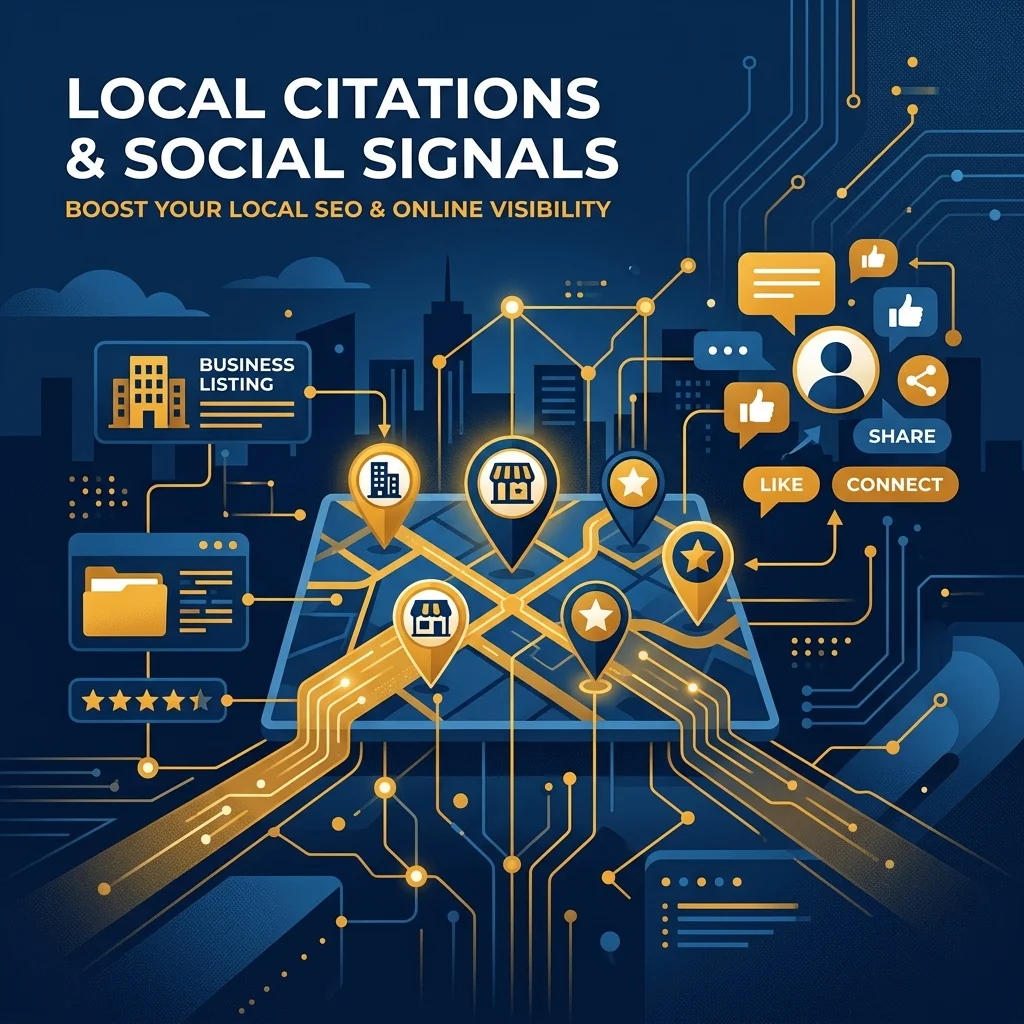
A Practical Guide for Business Owners & Beginners.
Table of Contents
- Introduction
- 1. Social Profiles for Rank & Rent Sites
- 2. Foundational Links
- 3. Dofollow vs. Nofollow — Brand Mentions Still Count
- 4. Local Business Citations
- 5. Types of Citations
- 6. Finding Citation Opportunities
- Quick Revision Checklist
- A Final Word
Introduction
Part 1 of this guide covered the defensive side of off-page SEO: how to recognize and avoid the links that damage a website. This second part covers the constructive side — the everyday, buildable work that establishes a website as a real, trustworthy business in Google's eyes before a single competitive backlink is ever pursued.
Three building blocks are covered here: social signals (a visible presence across the platforms people and algorithms expect a real business to occupy), foundational links (early-stage profiles on high-authority platforms that establish a website's basic digital footprint), and local citations (consistent listings of a business’s name, address, and phone number across the directories Google cross-references to verify legitimacy).
None of this work is glamorous, and none of it ranks a page by itself. But it is the layer everything else stands on. A website with no social presence, no foundational footprint, and no citation history looks, to Google, like it appeared out of nowhere — and nothing that appears out of nowhere gets trusted quickly, no matter how good its later backlinks are.
1. Social Profiles for Rank & Rent Sites
What It Means
For every Rank & Rent site, or any business site being built from scratch, a matching profile should exist on every major platform where customers and algorithms expect to find a real, active business. An empty search for a brand name that returns only the website itself, with no social footprint anywhere, reads as thin and unproven — to a visitor and to Google alike.
Build a complete profile — business name, description, and website link — on each of the following:
- X (Twitter)
- TikTok
- Tumblr
- Bluesky
- Threads
Two platforms are commonly left off lists like this, but carry real weight and are worth adding:
- YouTube — even a channel with no videos yet, fully profiled, is an entity signal on one of the most authoritative domains on the internet.
- Quora — a completed business profile plus genuine answers in your niche functions as both a citation and a direct lead source.
Keeping It Consistent: Automation
Sharing every new blog post across eleven-plus platforms by hand is unsustainable past the first few weeks. A plugin called Blog2Social solves this directly — it connects to the major platforms at once and automatically pushes new posts out the moment they publish. The time saved matters less than the consistency it protects: a profile that posts once and goes silent sends a worse signal than no profile at all, because it visibly demonstrates abandonment rather than absence.
REAL-LIFE EXAMPLE
A digital planners store sets up profiles on all eleven core platforms in a single afternoon, posts once on each, and stops. Three months later, most of those profiles look exactly as they did on day one — which, to a visitor clicking through from a search result, reads as a business that tried once and gave up.
A competing planner store connects Blog2Social to its blog before setting up any social profiles. Every new template release, every blog post, and every seasonal planner drop automatically appears across all platforms the same day it's published. Six months in, every profile shows a steady trail of recent activity — without the owner manually logging into eleven different apps each week.
2. Foundational Links
What It Means
A brand-new website has no history and no track record — which sounds like a disadvantage, but creates a real window of opportunity. A site’s Domain Authority is easiest to move in its first few months, before it has any established baseline. Foundational links (sometimes called seed links) take advantage of that window by placing a profile on platforms that already carry enormous trust with Google — not tiny blogs hoping to rank, but some of the most authoritative domains on the internet.
How to Get the Link From Each Platform
- Canva (canva.com): Create a free account, complete your profile bio, and publish at least one public design.
- Medium (medium.com): Sign up, complete the bio field, and publish one genuine article.
- Moz Community (moz.com/community): Complete your profile fully, then participate in at least one real discussion thread.
- Blogger (blogger.com): Create a blog connected to your business and complete the full profile with your website URL.
- IBM Community (community.ibm.com): Complete your profile, and join a relevant sub-community.
- Google Support (support.google.com): Participate in a relevant product forum (e.g., Google Business Profile Help).
- Amazon (amazon.com): Seller Central profile or Author Central profile.
- Samsung Community: Complete the profile fully.
- OpenAI Community (community.openai.com): Complete your forum profile and participate in at least one real thread.
- NVIDIA Developer Forums: Useful if your business touches anything technical or hardware-adjacent.
- Zoom Community: Complete your profile.
- iFixit (ifixit.com): Rewards genuine repair-guide contributions more than passive profiles.
- GitHub (github.com): Add your website URL in profile settings and ideally maintain at least one public repository.
- Behance (behance.net): Complete your profile and upload at least one real project.
A NOTE ON WIKIPEDIA
Wikipedia is deliberately left off this list as a link-building target. Adding a promotional link to an article violates Wikipedia's spam policy directly. Accounts doing this get blocked, and the domain itself can be added to Wikipedia's spam blacklist forever. If Wikipedia coverage ever happens, it should happen because independent, reliable sources wrote about the business first.
Rules That Prevent Most Blocks
- Empty or day-one profiles get suppressed. Add one piece of real content or one real interaction.
- Disposable or fake business emails get flagged. Use a real business email domain.
- Bulk, same-day sign-ups look automated. Spread foundational link building over two to three weeks.
- Most of these links render nofollow — and that's fine. They are about entity establishment and trust signals.
3. Dofollow vs. Nofollow — Brand Mentions Still Count
What It Means
A common and costly mistake is chasing only dofollow links while dismissing everything else as worthless. That view misses two other signals that matter more than most beginners realize:
- A dofollow link passes ranking value (sometimes called link juice) directly from the linking page to yours.
- A nofollow link doesn't pass that ranking value in the traditional sense, but it still functions as a trust signal, and can still send real referral traffic.
- An unlinked brand mention (your business name appearing in text with no hyperlink) still functions as an entity signal.
The practical implication: don't walk away from a placement opportunity just because a site will only offer a nofollow link or a plain text mention. A varied profile that includes dofollow links, nofollow links, and unlinked mentions looks exactly like the natural result of a business people genuinely talk about.
4. Local Business Citations
What It Means
A citation is any online listing of a business, typically through a directory or aggregator site. Citations work through a specific mechanism: consistency of NAP — Name, Address, and Phone number — across many listings. Google cross-references these listings to verify that a business is real and located where it claims to be.
Major Citation Sites
- Google Business Profile (the most important)
- Yelp
- Apple Business Connect
- Bing Places
- Foursquare
- BBB — Better Business Bureau
- Yellow Pages / YP.com
- Clutch
- Yahoo Local
Data Aggregators
A small number of platforms feed data out to dozens of smaller directories automatically:
- Data Axle
- Foursquare
- Neustar Localeze
5. Types of Citations
- Major: The broad, high-authority directories listed above. Build general trust.
- Niche: Directories specific to a particular industry. Builds topical trust.
- Regional: Directories tied to a specific city or region. Builds proximity signals.
- Unstructured: Mentions where NAP data is incomplete.
- Unclaimed: A listing exists on a platform but hasn't been claimed or verified.
- Stacked: AVOID. Multiple, inconsistent listings for the same business. Merge or remove duplicates immediately.
6. Finding Citation Opportunities
- Method 1 — Competitor Citations (Most Reliable): Use Google search operators like
allintext:"Competitor Phone Number"or"Competitor Brand Name"to find where competitors are listed. - Method 2 — Niche-Specific Search Operators: Find directories using
"[your niche]" + "directory"orinurl:"add-listing" "[your niche]". - Method 3 — AI-Assisted Search: Ask an AI tool for custom search operators for your niche and city.
- Method 4 — Direct Google Search: Search "top business citation sites".
- Method 5 — Citation-Checking Tools: BrightLocal, Whitespark, or Moz Local.
- Method 6 — Competitor Backlink Checkers: Ahrefs' free Backlink Checker.
Quick Revision Checklist
- Social profiles completed on all relevant platforms, including YouTube and Quora.
- Sharing automated with Blog2Social or a similar tool to keep activity consistent.
- Foundational links built on high-authority platforms, spaced over two to three weeks.
- Each foundational profile has real content or activity attached.
- Wikipedia avoided as a link-building target.
- Nofollow links and unlinked brand mentions treated as valuable.
- NAP format decided once and used identically across every listing.
- Google Business Profile claimed and complete.
- Competitor citation research run before building new citations from scratch.
A Final Word
None of the work in this booklet is exciting. Setting up a profile on Moz Community, claiming a listing on Ezlocal, or running a competitor's phone number through a search operator will never feel like the moment a business “wins” at SEO. But this is the layer that makes every later, more visible tactic actually work.
Apply the same rule from Part 1: 60% consistent implementation over 90 days beats a perfect plan abandoned in week two. Five foundational links done properly, spaced out and each with real content attached, will outperform fourteen done carelessly in one afternoon.
— Muhammad Yasin