Off-Page SEO: A Practical Guide for Business Owners & Beginners
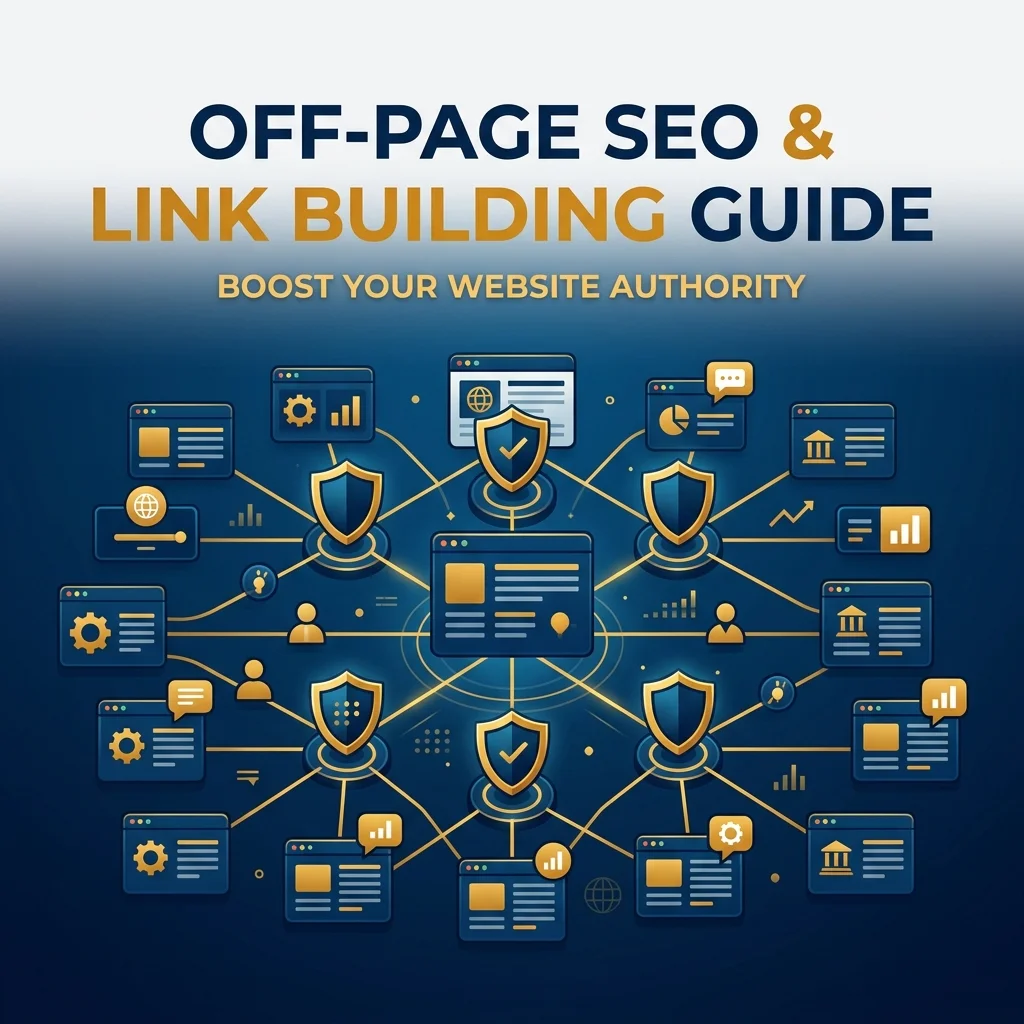
How other websites vote for yours and how to earn those votes safely.
Table of Contents
- Introduction: What Is Off-Page SEO?
- One Rule Before You Start
- Chapter 1: Keep the Spam Score Low
- Chapter 2: Avoid Bad Neighborhoods
- Chapter 3: Avoid Link Farms
- Chapter 4: Handle Auto-Approval Sites Carefully
- Chapter 5: Avoid High-OBL Pages
- Chapter 6: Evaluate Paid / Commercial Link Sites
- Chapter 7: Never Use Penalized Sites
- Chapter 8: Never Over-Optimize Anchor Text ⭐
- Chapter 9: Diversify Your Backlink Types
- Bonus Chapter: Extra Important Habits
- Quick Revision Checklist
- Final Assignment: Your First Real Audit
- A Final Word
Introduction: What Is Off-Page SEO?
Imagine a new restaurant opening in your city. The owner has done everything right inside the four walls: excellent food, clean tables, fair prices, a well-trained team. In SEO terms, that is on-page SEO—everything you control on your own website.
But here is the problem. On opening day, strangers walk past the door. They have never eaten there. They have no reason to trust it yet—no matter how good the food is.
What changes their mind? Outside word-of-mouth. A respected food blogger writes about the place. The owner of the popular shop next door tells his customers to try it. The local newspaper mentions it in a weekend feature. None of this happens inside the restaurant—it all happens outside, and that is exactly what makes it believable. The restaurant cannot fake other people's recommendations.
Off-page SEO is that outside word-of-mouth for a website. When other websites link to yours, mention your brand, or send you visitors, they are vouching for you. Google treats those signals the way a new customer treats recommendations: the more trustworthy and relevant the people vouching for you, the more Google trusts your site—and trust is what rankings are built on.
Every time Google evaluates your website, it is quietly asking one core question:
“Are other websites giving you a Vote of Confidence?”
This booklet teaches you how to earn those votes and, just as importantly, how to avoid the votes that hurt you. A recommendation from a respected source builds trust. A recommendation from a shady source destroys it. Off-page SEO is the skill of knowing the difference before you act.
One Rule Before You Start
You do not need to follow every rule in this booklet 100% of the time. That standard breaks people, and broken people quit. Instead, aim for 60% consistent implementation over 90 days. A backlink profile built steadily and mostly-correctly for three months will beat a “perfect” plan that gets abandoned in week two. Consistency compounds; perfectionism stalls. Keep that number in mind—we will return to it at the end.
Chapter 1: Keep the Spam Score Low
What It Means
Spam Score is a metric created by Moz, one of the most established SEO tool companies. It estimates the probability that a website looks like the kind of site Google penalizes. Moz studied thousands of penalized sites, identified the patterns they share (thin content, suspicious link patterns, spammy signals), and turned those patterns into a percentage from 1% to 100%.
A high Spam Score does not automatically mean a site is bad—but it means the site shares warning signs with sites that got punished. When such a site links to you, some of that suspicion can rub off on your website. Use this scale as your working guide:
- 0–10% Safe: Ideal link partners. Build links here with confidence.
- 10–30% Acceptable, with caution: Fine if the site is clearly real and relevant to your industry. Check it manually first.
- 30–60% Risky: Only consider if there is a strong, specific reason—and even then, most professionals skip these.
- 70%+ Avoid completely: No exceptions. No backlink is worth this risk.
REAL-LIFE EXAMPLE
A translation services company in Bahrain receives an email: “We will place your link in our business directory for $20.” The directory looks acceptable at first glance—clean design, English content, business categories.
A 30-second check with MozBar shows the directory’s Spam Score is 45%. Digging deeper, the directory links out to hundreds of unrelated sites: casinos, essay mills, crypto schemes. The clean design was a costume. The translation company declines, and instead spends the same $20 of effort getting listed in a legitimate Gulf business chamber directory with a 2% Spam Score. One of those two links builds trust for years; the other could have poisoned the whole profile.
How To Check It
- Install the free MozBar browser extension and create a free Moz account.
- Visit any website with MozBar switched on. The toolbar shows DA (Domain Authority), PA (Page Authority), and a spam indicator.
- For a full report, go to Moz Link Explorer, paste the domain, and open the “Spam Score” section.
- Record the score before you pursue any backlink. Make this a reflex: no score, no link.
Chapter 2: Avoid Bad Neighborhoods
What It Means
In every city there are streets where respectable businesses simply do not open an office—not because the building is bad, but because of what surrounds it. The internet has the same streets. In SEO, a bad neighborhood is a website or a network of websites built around industries that search engines treat with maximum suspicion: gambling, casinos, betting, adult content, illegal drugs, and weapons.
This is guilt by association. If your website’s backlinks live on the same pages as casino links and adult links, Google’s systems begin to wonder why a legitimate business keeps such company. You may never have done anything wrong yourself—the association alone is the damage. A single link from such a page rarely destroys a site, but a pattern of them marks you as part of that neighborhood.
How To Check It
- Manually browse the site before accepting or building any link. Open the homepage, the blog index, and 3–4 recent posts. Ask: what does this site actually publish, week after week?
- Use a Google
site:search to see what Google has indexed from the domain. Typesite:example.cominto Google and scan several pages of results. Then trysite:example.com casino. If those searches return results, the neighborhood has shown itself. - Check who else the site links out to. Open a few articles and look at the outgoing links. A site is defined by the company it sends its readers to.
Chapter 3: Avoid Link Farms
What It Means
A link farm is a website—usually a whole network of websites—that exists for one purpose only: handing out backlinks. It has no real audience, no real readers, and no reason to exist except selling or exchanging links. The “content” is filler: thin articles, copied text, or machine-spun paragraphs that no human was ever meant to read.
Google’s Penguin system was built specifically to detect unnatural link patterns like these. When Penguin identifies a farm, it does not just discount the farm—it devalues or penalizes the sites the farm links to. That is the trap: you pay for 200 links, and instead of rising, your rankings sink, because every one of those links is a signed confession that you tried to manufacture trust instead of earning it.
The test is always the same question: would this website exist, and would anyone visit it, if it stopped giving out links tomorrow? For a real blog, the answer is yes. For a farm, the site has no other reason to breathe.
How To Check It
- Check for real traffic. Paste the domain into Similarweb or Ubersuggest’s free traffic checker. A “blog” with hundreds of articles but almost no visitors is a farm wearing a blog’s clothes.
- Read the content like a human. Open three random articles. Spun or machine-stuffed text reveals itself in seconds.
- Look for signs of a real audience: comments, social shares, a named author with a history, a consistent topic focus. Farms have none of these.
- Check the outbound pattern: if every single article links out to different commercial websites, the site’s business model is selling links—and that is the definition of a farm.
Chapter 4: Handle Auto-Approval Sites Carefully
What It Means
An auto-approval site is any place where your comment or post goes live instantly, with no human review—open forums, blog comment sections, Q&A boards, and community sites. Because there is no gatekeeper, these places attract two kinds of visitors: genuine participants, and spammers dumping links by the thousand.
These links are not automatically worthless. A thoughtful contribution on a relevant, active forum can send real visitors, build your name in a community, and add a natural, diverse link to your profile. The same link, dropped as spam into an irrelevant thread, adds you to the pile of junk that Google learned to ignore years ago—or worse, associates you with it.
The dividing line is one question: are you contributing, or are you only collecting? A contribution answers the actual question, helps the actual reader, and would still be worth posting even if the link were removed. Spam exists only for the link.
How To Check It (Before You Post)
- Judge relevance first. Is the forum or blog genuinely about your industry, your city, or your customers’ problems?
- Check whether the community is alive: recent posts, real replies, active moderators.
- Read the rules. Many good communities allow links only in signatures or profiles—respect that.
- Apply the removal test to your own draft: if the link were deleted, would your post still be a useful answer? If not, rewrite it or do not post.
Chapter 5: Avoid High-OBL Pages
What It Means
OBL stands for Outbound Links—the number of links a page sends out to other websites. This matters because a page’s ability to pass trust is not infinite. Think of it as a cake shared among guests: whatever authority the page has is divided across every link on it.
If a relevant page links out to 10 sites and yours is one of them, you receive roughly 1/10 of the value it can pass. If a “links page” or directory dump links out to 500 sites, your share is 1/500—a crumb so small it changes nothing. Worse, pages with hundreds of unrelated outbound links are usually link-selling pages.
How To Check It
- Count manually for a quick check: right-click → View Page Source and search for
href=or simply scroll and count visible external links. Under ~20 on a normal article is healthy; hundreds is a warning. - Use a tool for accuracy: Moz Link Explorer and Ahrefs’ free Backlink Checker both report outbound/external link counts for a page.
- Combine with context: 30 outbound links in a genuinely useful “best resources” guide by a real author is fine. 30 outbound links to casinos, loans, and unrelated shops is a sales page for links.
Chapter 6: Evaluate Paid / Commercial Link Sites
What It Means
Sooner or later, every website owner meets the offer: “1,000 backlinks for $5.” Understand what that price actually tells you. Nobody can create 1,000 placements on real, trafficked, human-run websites for $5—the math is impossible. What $5 buys is automated spam.
At the same time, be precise about the lesson. Paid placements are not inherently bad. Real publications charge for sponsored posts; niche sites charge for placements; that is a normal market. The rule is that quality must be verified before price is even discussed.
How To Check It
- Always request samples—3–5 example placements the seller has done for other clients. A refusal to show samples is itself the answer.
- Run every sample through your existing toolkit: Spam Score (Ch. 1), neighborhood check (Ch. 2), real-traffic check (Ch. 3), OBL count (Ch. 5).
- Confirm relevance: would this site’s real readers plausibly care about your business?
- Only after the samples pass every check does the price become a topic. Quality first, price second—never the reverse.
Chapter 7: Never Use Penalized Sites
What It Means
A Google penalty is a punishment applied to a website that violated Google’s guidelines. A penalized site loses its rankings, its traffic, and critically for you—its ability to pass trust to anyone else.
A backlink from a penalized site is at best worthless and at worst a fresh association with a convicted offender. The problem is that penalized sites do not wear a sign. They often still look fine. The evidence lives in one place—the traffic history. The signature of a penalty is a sudden, steep, permanent collapse in traffic or rankings.
How To Check It
- Pull the traffic history graph. Free options: Ubersuggest’s “Traffic Overview”, Similarweb’s free view, or Ahrefs’ free Website Traffic Checker. You are looking at the shape of the line.
- Read the shape: gradual slopes and seasonal waves are normal life. A cliff—sharp drop, no recovery—is the penalty signature.
- Search for public discussion: Google the domain name together with words like “penalty,” “deindexed,” or “traffic drop.”
Chapter 8: Never Over-Optimize Anchor Text ⭐
If you remember only one chapter from this booklet, make it this one. Anchor text over-optimization is the single most common reason otherwise-careful websites get hit by link penalties.
What It Means
Anchor text is the visible, clickable text of a link. Google reads anchors as tiny descriptions of the page being linked to. When real people link to you voluntarily, they write your brand name, or paste your bare URL, or type “click here.” Almost nobody naturally writes your money keyword as the anchor. So when Google sees a profile dominated by exact-match keyword anchors, it is not seeing popularity—it is seeing fingerprints.
The Healthy Anchor Text Mix
- Brand Name 40–50%: “Shamil Translation,” “Printable & Digital.” The backbone of a natural profile.
- Naked URL 20–30%: “www.example.com” pasted as-is. Real people do this constantly.
- Generic 15–20%: “Click here,” “this website,” “read more,” “source.”
- LSI / Variations 10–15%: Related phrases and partial matches: “document translation help.”
- Exact Match Keyword only 5–10%: Your precise money keyword. This is seasoning, not the meal—a small amount sharpens the signal; more than that poisons it.
How To Check It
- Pull your anchor report in Moz Link Explorer or Ahrefs.
- Group every anchor into the five categories above.
- Calculate the percentage of each category out of the total.
- Compare against the healthy ranges. If Exact Match is above ~10–15%, stop building keyword anchors entirely until the ratio recovers.
Chapter 9: Diversify Your Backlink Types
What It Means
A genuinely popular business gets talked about everywhere, in every format: mentioned in directories, cited in articles, shared on social media, discussed in forums. Its backlink profile is naturally a mixture. A manufactured profile looks different: it is one type of link, repeated 300 times. Real popularity never looks that tidy. Diversification is how your profile tells a believable story.
The Types To Mix
- Citations: Google Business Profile, local directories, chambers of commerce.
- Foundational links: Social platforms, industry registries, review sites.
- Social shares: Your content shared on Facebook, LinkedIn, X, Pinterest.
- Web 2.0 properties: Content you publish on platforms like Medium or Blogger.
- Blog comments & Forums: Genuine contributions on relevant posts/boards.
- Niche edits: Your link added into an existing, already-ranking article.
- Guest posts: Full articles you write for other relevant sites.
- Podcasts: Guest appearances (show notes usually link to you).
Bonus Chapter: Extra Important Habits
- Keep a Dofollow + Nofollow Mix: Beginners chase dofollow only—and that is a mistake. A profile that is 100% dofollow looks manufactured. Welcome nofollow links from real, relevant places.
- Respect Link Velocity: Link velocity is the speed at which new backlinks appear. Trust is built gradually. Plan your link building as a drip, never a flood.
- Prioritize Niche Relevance: A link from a website in your own industry is worth far more than a link from an unrelated one, because relevance is part of the vote.
- Index Your Links: A backlink Google has never seen has zero value. Search Google for
site:theirdomain.com/the-page-url. If it isn't there, help it get indexed by sharing it on social media.
Quick Revision Checklist
Before pursuing, accepting, or paying for any backlink, run down this list:
- Spam Score checked: 0–10% ideal, above 30% skipped, 70%+ never.
- Neighborhood vetted: no gambling, casino, betting, adult, drugs, or weapons content.
- Not a link farm: the site has real traffic, real readers, and content a human would read.
- Auto-approval placements are genuine: every comment passes the removal test.
- OBL counted: my share of the page’s value is a meaningful fraction.
- Paid offers vetted by samples: bulk $5 offers rejected on sight.
- Traffic history pulled: no penalty cliff in the site’s past.
- Anchor text planned: exact-match keywords held to 5–10%.
- Backlink types diversified: no single type dominating the recent profile.
- Dofollow/nofollow mix maintained: nofollow links welcomed, not avoided.
- Link velocity steady: links arriving as a drip, never a spike.
- Niche relevance confirmed: the site’s real readers could plausibly become customers.
- Indexing verified: every earned link checked with a
site:search.
Final Assignment: Your First Real Audit
Everything in this booklet was practice for this moment. This capstone takes the individual skills and combines them into the complete workflow a professional uses.
Step 1: Pick One Real Website
Choose a website you genuinely care about: your own business, a client’s, or a local business you know. It must be real—the whole point is making decisions with real consequences.
Step 2: Find 10 Backlink Opportunities
Hunt across different types (Chapter 9): directories, forums, guest-post targets, a niche-edit candidate, a Web 2.0 platform. Check where competitors get their links.
Step 3: Build the Evaluation Table
Evaluate all 10 opportunities using the skills from Chapters 1–9. Fill one row per opportunity: Website, Niche Relevance, Spam Score, OBL Count, Real Content, Verdict, Planned Anchor Text Type.
Step 4: Reject the Failures
Any opportunity failing the core safety chapters (Spam Score, bad neighborhood, link farm, or penalty history) gets the verdict “Reject,” no matter how easy or cheap the link would be.
Step 5: Plan the Anchor Text Mix
Across the surviving opportunities, assign anchor types so the whole set respects Chapter 8’s percentages: mostly brand name and naked URL, some generic, a little variation, and at most one exact-match anchor across the entire batch.
Step 6: Write Your 90-Day Link-Building Plan
Finish with a short written plan answering four questions: Pacing, Sequence, Diversification, and Follow-up.
A Final Word
Remember the rule from the very first page: you do not need 100%. You need 60% consistent implementation for 90 days.
Sixty percent means some weeks you will only manage the Spam Score checks and one good forum contribution—that still counts. What it does not mean is stopping. The person who applies these rules imperfectly for three months will look back at a backlink profile and rankings that the perfectionist who quit in week two will never have.
Ninety days of 60% consistency puts you at a new level of results. Start with Chapter 1’s assignment today.
— Muhammad Yasin